



From Identity Backlog to 1-Click Execution: Deploying Redblock AI Agents in SailPoint
Table of Contents
If you run an identity program, you already know the pattern. Year one is spent on a small set of tier-1 apps. By year three, you’ve made progress, but a big chunk of the enterprise stack still isn’t under consistent identity execution.
Those “other” apps are the problem. Not because they’re unimportant, but because they’re hard. Many don’t have mature APIs. Some have no usable connectors at all. A lot of the work still happens the old way: CSV exports, manual cleanups, and tickets that sit in queues.
That gap between identity strategy and identity execution is what we call the Identity Backlog. A backlog is a security issue. It’s the reason offboarding takes too long, access drift accumulates, and reviews turn into “best effort” exercises.
One simple idea drives the rest: Coverage velocity determines risk. If it takes years to execute your identity strategy across your stack, your risk window stays open for years. Today, we’re shrinking that window.
What’s New: 1-Click Deployment into SailPoint
We reached a new milestone when a customer asked: "If Redblock AI Agents complete a JML change in under 5 minutes, why should it take an hour to set up the agent in SailPoint?"
By integrating directly with SailPoint’s APIs, we’ve automated the setup. Redblock now collects the required metadata of the agent and provides a simple accelerant: 1-click deploy of a new source in SailPoint.
- Less setup work: Identity teams can deploy agents into their existing environment and begin coverage immediately.
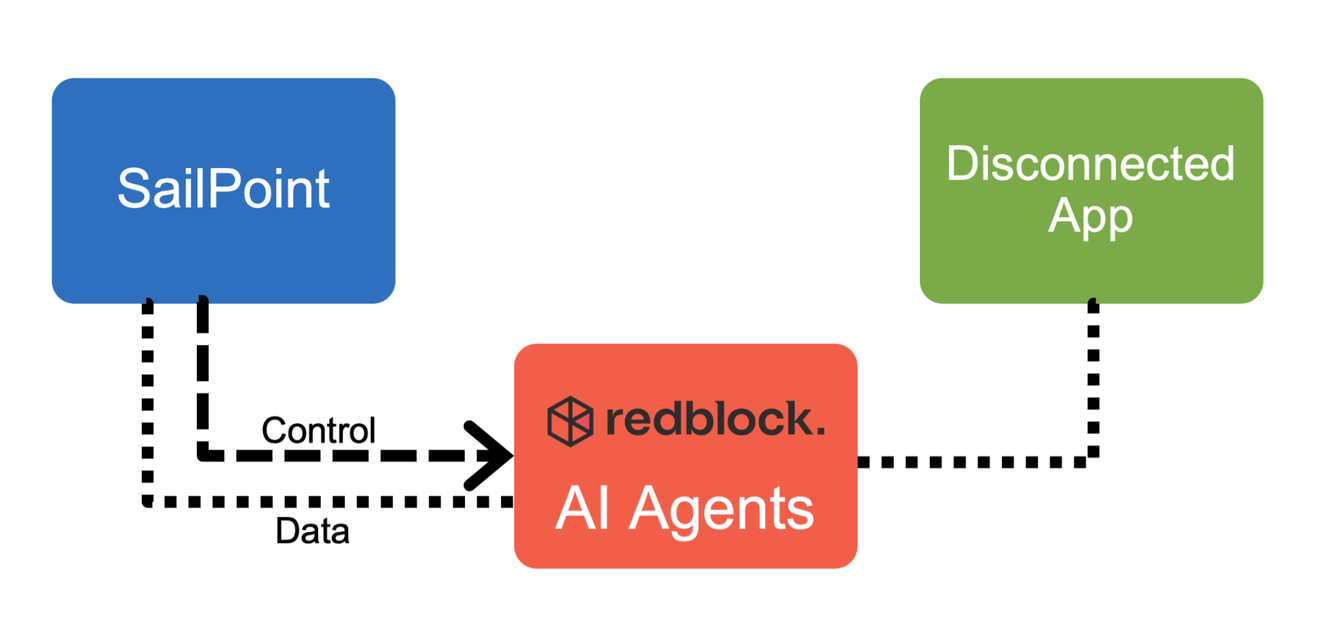
- Governance-first: SailPoint remains the control plane for policy, approvals, and audit.
- Execution layer: Redblock acts as the “hands,” translating those policies into deterministic action across disconnected applications.
How it Works: See the Integration in Action
Rather than explaining the technical plumbing, we want to show you the speed. In the demo below, you will see a Redblock AI Execution Agent move from a standalone tool to a configured SailPoint source in seconds.
As shown in the video, Redblock performs core identity functions across hard-to-integrate applications, replacing manual workflows with governed software:
- Account Aggregation: Discover and sync users, roles, and entitlements from disconnected apps.
- Lifecycle Automation (JML): Execute joiner, mover, and leaver changes consistently.
- Access Remediation: Enforce updates and policy corrections deterministically.
- Audit Evidence: Capture before-and-after snapshots to speed up compliance tasks.
The Boring but Critical Part: Inline ETL
One thing we see constantly: the data is there, but it’s not usable. IDs don’t match and fields are inconsistent. Normally, someone has to clean this up manually before it flows into your IGA program.
Redblock handles this inline. Our agents normalize and clean data before it’s synchronized into SailPoint. This ensures what gets ingested is structured and policy-aligned without someone babysitting a spreadsheet.
Agentic AI, Without the Hype
Yes, this is agentic AI, but not in the “let it roam free” sense. Our agents operate inside strict guardrails: policy-bound actions, deterministic checks, and audit-ready evidence. The point isn’t creativity. The point is reliable execution.
Frequently Asked Questions
Does this support SailPoint IdentityNow (SaaS) or IdentityIQ (on-prem)?
The 1-click deployment currently supports SailPoint IdentityNow. For IdentityIQ, we generate a payload which can then be applied to IIQ.
What permissions does the Redblock Agent require within SailPoint?
Redblock follows least privilege. To enable 1-click setup, the integration requires a token with scoped administrative permissions to create and configure the required SailPoint objects. This token is required as a one-time use for setup.
How does Redblock handle disconnected apps without APIs?
When an app lacks an API, the Redblock agent executes through the application’s administrative interface, similar to how a human operator would, then transforms the result into structured data that SailPoint can ingest.
What happens if the target application’s UI changes?
Traditional scripts often break when layouts change. Redblock agents are designed to be more resilient by using multiple signals (structure, labels, and context) to locate the right controls. If a breaking change prevents safe execution, the agent stops and alerts an admin.
Is there a human-in-the-loop (HITL) safety check?
Yes. While deployment is rapid, execution is governed by your SailPoint policies. You can require approvals in SailPoint before any write action (like disable or delete) is performed downstream.
Close Your IAM Blast Radius.
See how Redblock replaces ticket-driven identity execution with continuous lifecycle enforcement across your application estate.