



The Nuance of Automation: RPA vs Computer Use Agents

Table of Contents
Automation is often treated as a monolith, but for enterprise technology teams, the choice between Robotic Process Automation (RPA) and emerging Computer Use Agents is the difference between a brittle, maintenance-heavy program and a resilient, scalable one.
To understand why this distinction matters, we must first look at how these technologies actually interact with the applications we rely on.
Robotic Process Automation (RPA): The Deterministic Replayer
RPA tools (like UiPath or Blue Prism) operate on a "record and replay" paradigm. A developer captures a sequence of interactions—clicks, keystrokes, and navigation paths—mapping them to specific, static UI coordinates or code selectors (like CSS paths or XPaths).
- The Pro: When the application environment remains identical, RPA is fast, highly deterministic, and easily auditable. It is perfectly suited for high-volume, "stable" workflows where the UI never changes.
- The Con: RPA is inherently brittle. If an application updates its interface—if a field moves, a modal pops up, or a button label changes—the script breaks. Every change requires developer intervention, creating a "maintenance tax" that often consumes the majority of an automation team's time.
Computer Use Agents: The Visual Interpreter
Computer Use Agents represent a fundamental shift. Rather than following a rigid script, these agents operate more like a human operator. They receive a goal, take a screenshot of the current application state, interpret the visual and semantic context, and decide on the next action.
- The Pro: They are resilient. Because the agent "understands" the interface (e.g., it knows where the "Submit" button is, even if it has moved), it adapts to changes automatically. It doesn't need to know the specific X/Y coordinate; it simply finds the intent.
- The Con: They are fundamentally different from RPA in execution style. They are generally slower than deterministic scripts, and because they reason through steps, their audit logs look more like high-level task summaries than precise coordinate-level replays.
The Identity Reality: Why Enterprises Are Drowning in Manual Labor
For the past two decades, enterprises have invested billions into Identity Governance and Administration (IGA) and Privileged Access Management (PAM) to govern "who has access to what." These platforms are excellent at managing the "front door"—the top 10–20% of applications with mature APIs.
However, the remaining 80% of the application landscape—legacy systems, niche business tools, and custom internal portals—has been left in the dark. These are the "disconnected apps" that lack programmatic interfaces. Because IGA platforms cannot speak to these applications, the "last mile" of identity execution falls back to manual human labor: IT tickets, spreadsheets, manual provisioning, and tedious account reviews.
This creates a massive identity security debt. When access is managed via manual ticket queues, it is slow, error-prone, and leaves the enterprise vulnerable to orphan accounts and standing privileges that are never properly deprovisioned.
Redblock: The Missing Identity Execution Layer
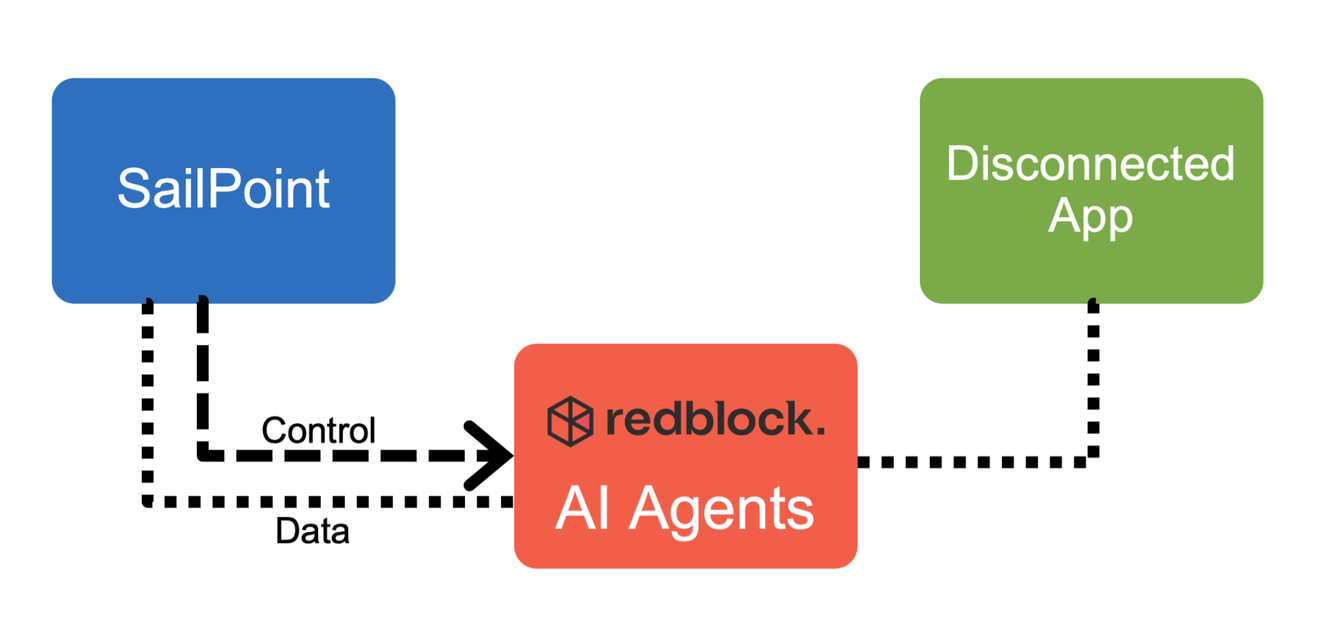
Redblock does not attempt to replace your governance platform (like SailPoint, Saviynt, or Okta). Instead, we provide the missing Identity Execution Layer that operationalizes governance decisions.
We utilize Agentic AI—specifically purpose-built, guardrailed Computer Use Agents—to bridge the gap between governance intent and real-world application state. Here is why this architecture is the key to solving enterprise identity debt:
- Deterministic Execution within Agentic Freedom: While generic agents can be unpredictable, Redblock agents operate within strict, policy-bound identity boundaries. We convert your governance rules into deterministic, verified actions.
- Continuous Identity Assurance: Redblock doesn't just "act"; it validates. We perform state comparisons—checking the application before and after an action—to ensure the identity lifecycle event (like a JML—Joiner, Mover, Leaver—action) was completed successfully. We then synchronize that proof of execution back to your IGA platform, providing a closed-loop audit trail.
- Enabling Agentic Security: By moving beyond the limitations of brittle RPA scripts, Redblock allows enterprises to bring the "long tail" of their application portfolio into active governance. We transform manual ticket-driven identity operations into always-on, software-driven execution.
The future of identity is not just about making better decisions; it is about guaranteeing that those decisions are enforced across every single application in the enterprise. Redblock acts as the "muscle" for your governance strategy, enabling you to finally close the identity coverage gap and move toward a state of continuous, automated identity assurance.
Close Your IAM Blast Radius.
See how Redblock replaces ticket-driven identity execution with continuous lifecycle enforcement across your application estate.